Tarmac and Trust: A Road Repair Contract Worth Signing
There is a particular kind of anger that comes from a damaged wheel. It is not the grand anger of national politics. It is quieter and more practical. It arrives on a wet Tuesday morning when a working person hears the crunch of alloy against tarmac, pulls over, and calculates whether the repair bill will come out of the food shop or the heating budget. For too long, road maintenance has been treated as an unavoidable background nuisance rather than a basic public service. It is time to change that, and to do so in a way that can be seen, read and tested by the people who pay for it.
A road is not a decorative surface. It is the infrastructure of ordinary life. It carries the care worker to a double shift, the apprentice to college, the delivery driver to the depot and the parent to the school gate. When it is neglected, the cost is not borne by a distant spreadsheet. It is borne by households already stretched, and by cyclists and pedestrians who are exposed to the consequences of a repair regime that too often amounts to patch-and-hope.
The case for a published works map
The first reform is simple: publish the plan. Every council should be required to set out, month by month, which streets will be repaired, when the work will begin and how long it is expected to take. That map should be available online in plain English, updated on a fixed date, and broken down by ward so that residents can see what is happening on their own street rather than hearing vague assurances about a future programme.
This is not a demand for bureaucratic perfection. It is a demand for respect. If a council knows that a road is scheduled for resurfacing in June, residents should know it too. If a repair has been delayed, the reason should be stated. If a stretch of road has been assessed and judged a lower priority, that judgement should be explained. Transparency of this kind does not create extra work; it removes the fog in which poor performance survives.
A published schedule also makes it harder for maintenance budgets to be raided quietly when other pressures emerge. Sunlight is a useful disinfectant, and a monthly works map is a modest dose of it.
Ring-fence the repair budget
Good intentions are easily undone by accounting. Too often, money allocated for highway maintenance is moved sideways to plug gaps elsewhere, leaving the repair backlog to grow while the press release boasts of investment. That practice must end.
Within the local transport settlement, a clear and substantial share should be ring-fenced for road repair and resurfacing. Councils should report annually on how much was allocated, how much was spent and what condition the network is in. The reporting should be comparable across authorities, so that residents can see whether their council is keeping pace or falling behind.
This is not about removing local discretion. It is about making sure that the basics are funded before the extras are considered. A town that cannot keep its roads safe is not in a position to celebrate a new civic centre, however welcome that centre might be. Working people understand the difference between a ribbon-cutting and a repair that lasts.
Dig once, fix it properly
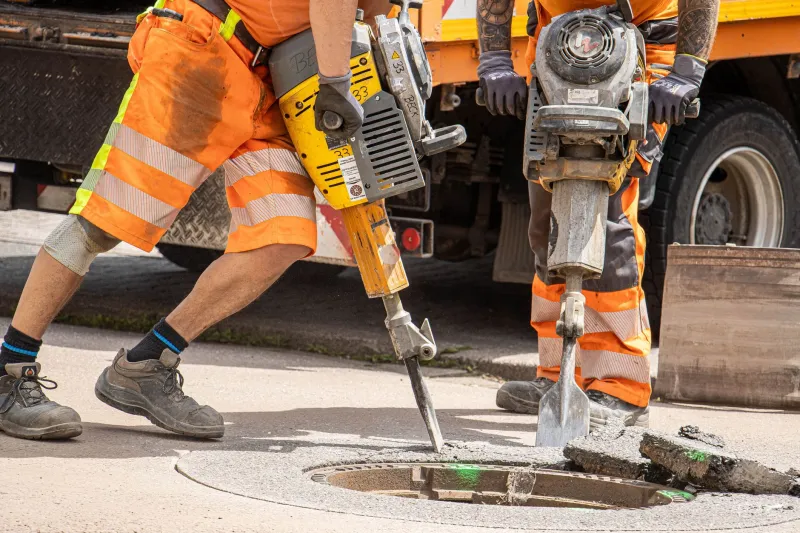
A significant share of damage is caused not by winter weather but by utility works. A company digs a trench, fills it in, and within months the surface is sinking. The patch fails, the road deteriorates and the public purse is asked to pay for the consequences.
It is time for tougher standards after every utility dig. Rehabilitation should be required to a proper depth and specification, not merely a cosmetic skim. A warranty period should apply, with the utility company liable for failure within a defined timescale. Inspections should be routine rather than exceptional, and the results should be published alongside the works map.
Where a company repeatedly fails, the consequences should be meaningful. That might mean a bond, a levy or a restriction on future permits until standards improve. The principle is straightforward: if you open the road, you restore it to a proper standard, and you stand behind your work. The public should not pick up the bill for a job that was never finished properly in the first place.
A simple route to compensation
When a road has been neglected and a driver or cyclist suffers damage, the current system is often slow, legalistic and intimidating. Many people give up because the process is harder than the loss. That is not justice; it is attrition.
A standard compensation route should be available, with a short and simple form, clear evidence requirements, fixed timelines for response and a published record of outcomes. Cyclists should be explicitly included, not treated as an afterthought. Where liability is accepted, payment should follow promptly. Where it is disputed, the reasons should be given in writing.
This is not about encouraging claims. It is about ensuring that public authorities take responsibility when their neglect causes harm. A fair system is also a deterrent: it concentrates minds on prevention.
A test of respect
None of these proposals is revolutionary. They are practical measures that would make a visible difference to daily life. But together they amount to a test of whether local government respects working people's time, their safety and their money.
A pothole is small until it is your pothole. A repair schedule is dull until it is your street that is waiting. The Labour case for our towns is that the basics matter, that competence is a form of fairness, and that public money should produce public value that people can see. Tarmac and trust are not usually spoken of in the same sentence. They should be. A road repair contract worth signing would put the two together, and ask every council to sign up in public.